Founded in 1979 in Seattle, the company grew rapidly – also through a series of acquisitions. Among them was the Dutch printer Paro in Eindhoven, which had already established itself successfully in the print-on-demand sector. Today the company operates as RPI Europe and employs, around 100 people across a two shift work pattern. Up to 6,000 books leave the production facility daily, with an average run of 1.8 copies; in peak times, they can despatch up to 9,000 books.
“We have grown rapidly in recent years with increases of 20% per year,” says Sven Lambrechts, Vice President Technology and Workflow, RPI Print. “In addition to our own e-commerce channels, we also work for several large global brands. Furthermore, creative platforms and apps are important customers for RPI; consumers design their own products there, simply click the ‘Print’ button, and we take care of everything else – including production and shipping.”
Seen and Convinced
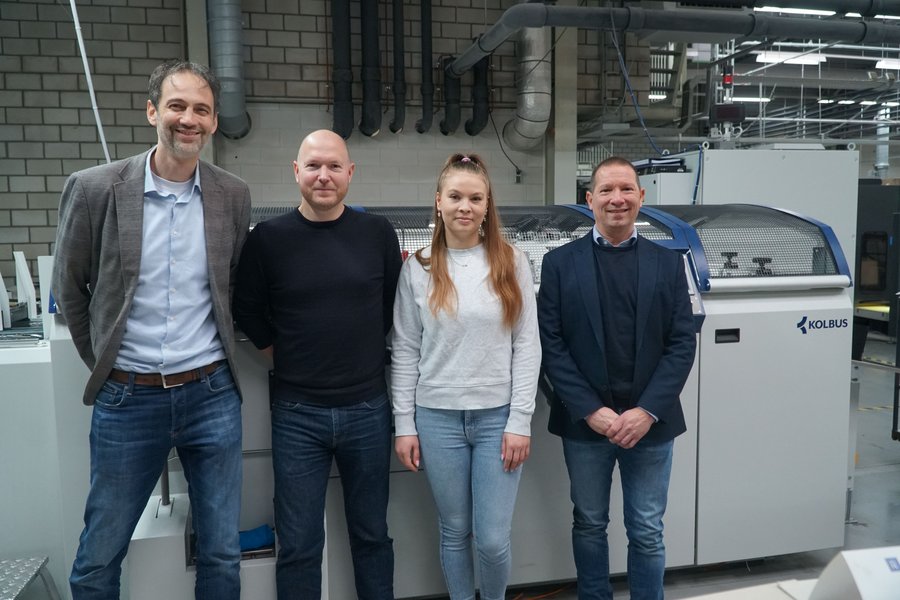
The enormous growth eventually made investments in technology necessary, especially in the automation of book manufacturing. “We looked around the market and had already shortlisted a few cover machines,” says Lambrechts, “but when we saw the prototype of the Kolbus DA 160 at drupa 2024, the decision was made immediately.” However, the machine was only a prototype and not yet available.
So Kolbus proactively offered RPI the larger sister model DA 260 as a transitional solution. In September 2025, the DA 160 was finally delivered. The DA 260, however, was not returned to Kolbus; RPI bought it as well and sent it on a journey to the RPI plant in Atlanta, where it complements existing Kolbus casemakers. “In Atlanta we produce more uniform formats with little variance, for which the DA 260 is well suited. The DA 160, on the other hand, gives us here in Eindhoven the format flexibility we need for our product range,” says Lambrechts. “We offer around 40 formats, including small formats. The machine is perfectly suited for that.”
And most importantly: the products are sales-ready from the first sample – there is no waste. Great praise for the Kolbus service and the Dutch distributor Adkow as well: smaller technical difficulties were resolved quickly. “The Kolbus engineers immediately understood what we needed,” concluded Lambrechts.
Source: Die Grafische Palette